
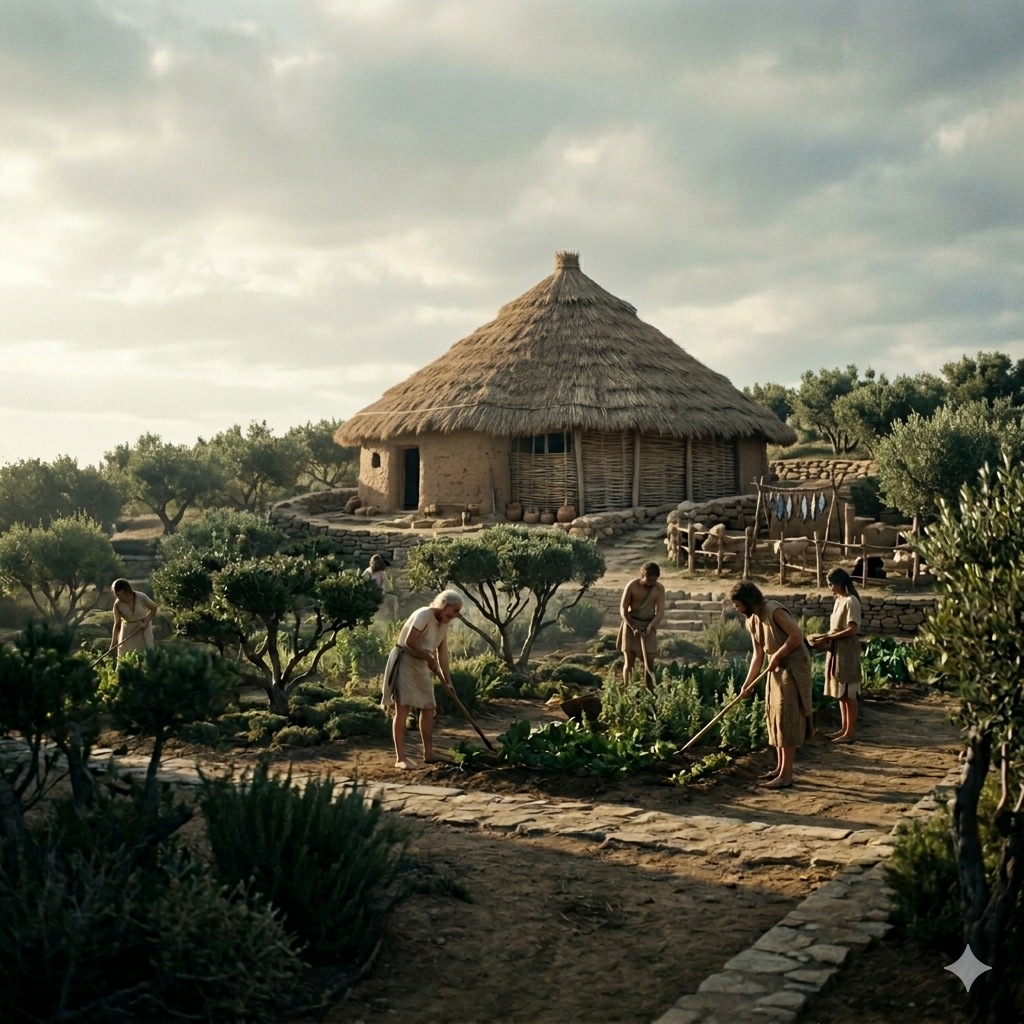
According to contemporary fossil and archaeological records, ancient human populations dating back up to 3,300,000 years ago (yes, more than 3 million years ago) were actively managing and cultivating vast territories. They utilized complex, integrated landscape engineering combined with sophisticated tool manufacturing and use to create subsistence environments, primarily through agroforestry and sustainable land management techniques.
Furthermore, despite those ancient human populations being way smaller than today, the area they needed to manage in order to reproduce and survive was far larger than the agricultural zones we currently use.
Alongside this, the physical evidence also suggests that humans have always been settlers. Several archaeological sites feature findings spanning millennia in the exact same location, indicating that multiple generations inhabited the same area for thousands of years.
So, if the empirical data states that humans have always been farmers and settlers, what actually happened 10,000 years ago?
Well, the records show that 10,000 years ago wasn’t the sudden start of farming, but rather the peak of a process that had already been underway for at least 40,000 years – domestication.
Domestication is a phenomenon that deeply alters the biology, lifespan, reproduction, and behavior of all the diverse species involved in it. In the case of humans, it is the force that shifted our behavior away from autonomous environmental integration and regulation toward a rigid compliance with the very species we were managing (and being managed by).
Especially through mono-culture farming, domestication allowed the human population to grow exponentially, survive, and thrive on the Earth’s surface over the last 10,000 years.
The caveat of domestication is that, evolutionary speaking, it is a process that happens too fast. The biology of the species involved rarely keeps up with the pace; while their reproductive rates scale exponentially, their survival rates and individual longevity often decrease.
Specifically in humans, domestication has historically taken a heavy toll on overall health and longevity—a trend that only began to reverse over the last 50 years as global life expectancy started to rise.
However, we do not need to wait generations for evolutionary biology to catch up. Given the technology and resources available today, learning from ancient land management offers a fast track to optimizing modern human well-being and longevity.
By applying farming methods that are inherently more aligned with human biology through automated, high-yield food production right into our cities, we can integrate and optimize our direct biome. Thus, integration with nature becomes a matter of technology and spatial design.
Furthermore, by utilizing a global digital network to share cultivation data and ecological blueprints, modern communities can increase production and adapt these hyper-localized food systems to their geographical needs.
In order to heal our bond with the ecosystems around us, we don’t need to abandon the future— we just need to design it better.
We can finally build a sustainable lifestyle that feels entirely native to us—one where we design environments and spaces that don’t just shelter our bodies, but actually support our biology.