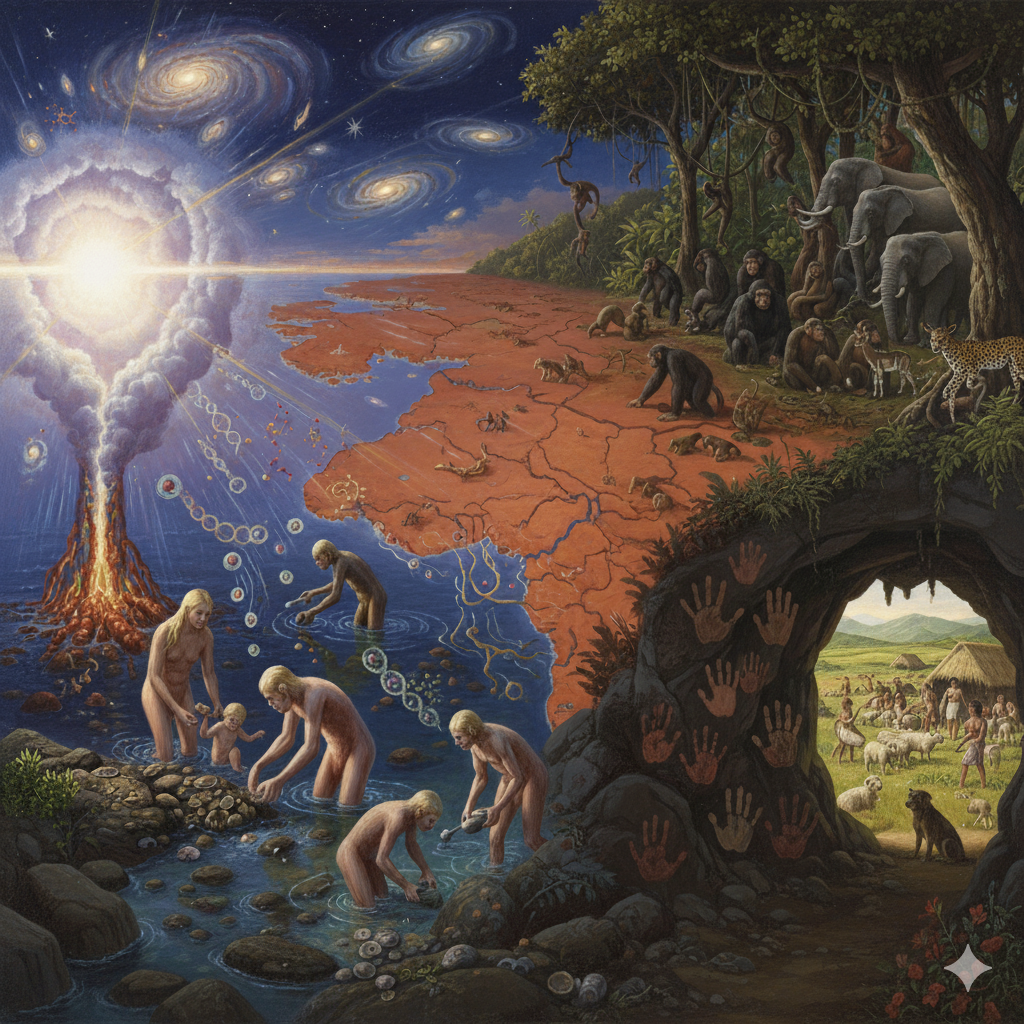
An evidence based narrative about the Universe, Planet Earth, Life, and Humankind
Since humans began inhabiting the Earth’s surface, approximately 600.000 years ago (or 1.800.000 years ago, depending on the evidence considered), they (like other animals) sought to understand themselves and their surroundings, gathering knowledge in order to better reproduce and survive.
By 5000 years ago, humans started to register the knowledge (which they consider to be fundamental for their reproduction and survival) in the form of written records. In turn, the ancient written records have granted the following human generations very limited yet very important access to the ancient human world.
Interestingly, from what contemporary humans can (so far) interpret from those ancient written records, it appears that they are (almost entirely) related to a system of beliefs, centered on a connection to the spiritual or the supernatural.
These systems provide moral guidance, and more importantly, they function as a powerful social glue, gathering large, disparate groups of humans under a shared set of dogmas and a common identity.
Over the last 500 years, humans have been intensively documenting, accumulating, and systematically organizing their knowledge (and beliefs) about nature (in its broadest sense) through observation and experimentation, in an intellectual and practical activity called science.
It is important to highlight that since its emergence (and especially in its beginnings), science has been formalized as an intellectual path to the truth, mediated by divine revelation, in other words, a means to confirm the spiritual and supernatural through rationality and the human intellect.
Therefore, science has been operating mainly as a way to find evidence that proves the dogmas or the very existence of the diverse systems that humans believe in the spiritual (or supernatural).
This intricate association between empirical science and metaphysical beliefs has persisted into our modern era. Over the last 35 years, academic fields such as Big History, as well as books, TV shows, and various forms of media, have been attempting to make sense of human existence on Earth from a more scientific perspective.
Despite having significantly more data and empirical evidence (compared to 500 years ago, when science itself was still crawling), the “modern” science often finds itself walking a tightrope.
To remain palatable and relevant within a global culture, still deeply rooted in spiritual traditions, it frequently adopts a posture of deference. It presents itself not as a replacement for creation myths, but as a complementary, “modern origin story” that can sit alongside them.
Therefore, science today heavily depends on the promotion (and perpetuation) of dogmas and the very existence of diverse belief systems that humans hold regarding the spiritual (or supernatural), purposefully avoiding a direct confrontation with them.
Over the last 20 years, the Internet (which was first researched about 65 years ago, then became available to the general public about 30 years ago, but really took off in terms of volume of usage and content about only 15 years ago) has been able to democratize access to all kinds of data and knowledge, making the present time unprecedented in history regarding access to information.
Given this recent scenario full of possibilities, an interesting mission started to take shape. Would it be possible, by accessing the Internet, to disentangle the vast scientific knowledge based exclusively on empirical evidence into a cohesive, compelling narrative about the origin and unfolding of the universe, planet Earth, Life, and humankind?
Within these premises, the mission unfolded (over some years) in chronological sequence, following the events that brought humans into existence from the past to the present day.
There was no specific goal to be reached or a thesis to be proved.
The main objective was to simply substantiate the available scientific knowledge based on empirical evidence regarding the universe, planet Earth, Life, and humankind.
After some years, the mission resulted in a thought-provoking publication, an artwork of liberation, intellectual honesty, and the reality of the human circumstances, whose delivery is as factually rigorous as it is narratively compelling – Beliefs of a Female Architect.

In its first part, called Space, Beliefs of a Female Architect offers an overview of what happened in the universe from the Big Bang to the formation of the Moon and Earth (based exclusively on empirical evidence) in accordance with the factual cosmological sequence of events. It starts with the universe’s Origins (13.800.000.000 years ago), then moves through the ensemble of the Solar system (5.103.200.000 years ago) until the onset of the intertwined Earth-Moon relationship (4.568.200.000 years ago).
In its second part, called Life, Beliefs of a Female Architect goes a little deeper into Earth’s dynamics that enabled Life to take place (also based on empirical evidence), this time displayed according to the factual planetary sequence of events. It starts with Earth’s (still kind of) controversial beginnings (4.510.000.000 years ago), then progresses through the ensemble of the surface (4.000.000.000 years ago), until the point where the continents started to get roughly shaped as we know them (700.000.000 years ago).
In its third part, called Monkeys, Beliefs of a Female Architect provides a generous overview of current scientific knowledge (still based on empirical evidence) about the physical development of a special kind of monkey (humans) and how those monkeys (humans) have been organizing themselves on the Earth’s surface throughout time. The narrative considers the timeline of the factual sequence of planetary events, along with the monkey’s (human) development, as its pathway. It starts with a closer look into the interpretation of Fossils (from 34,000,000 years ago and on), then making sense of how the monkey (human) appropriated, experienced, transformed, and was affected by the Earth’s surface diverse Territories (from 5.330.000 years ago on) to finally realize how humans ended up living in Captivity (since 15.000 years ago).
The author of Beliefs of a Female Architect is a human architect. Since architecture itself is part of the empirical evidence of humans inhabiting the Earth’s Surface, architecture is also a portion of the narrative. However, Beliefs of a Female Architect is not a publication about architecture, nor is it exclusively for architects.
Beliefs of a Female Architect is a publication for all humans. Students, academics, scientists, intellectuals, philosophers, architects, engineers, mothers, fathers, and above all, to all individuals who are simply curious about what humans actually (evidence-based) know so far about themselves and their place in the universe.