Resignify Studio

Humans     Architecture      Design     Reading

Author: Priscila Cheib Duarte

  • Book Design Matters

    Book Design Matters

    How Outdated Design Is Sabotaging Your Reading

    Books are responsible for a massive part of human development and an active determinant in human history. 

    By documenting human knowledge across the most diverse fields, books have been a technology that, for centuries, has shaped minds and civilizations through a silent conversation across time and space, becoming a pivotal human event in cognition and communication.

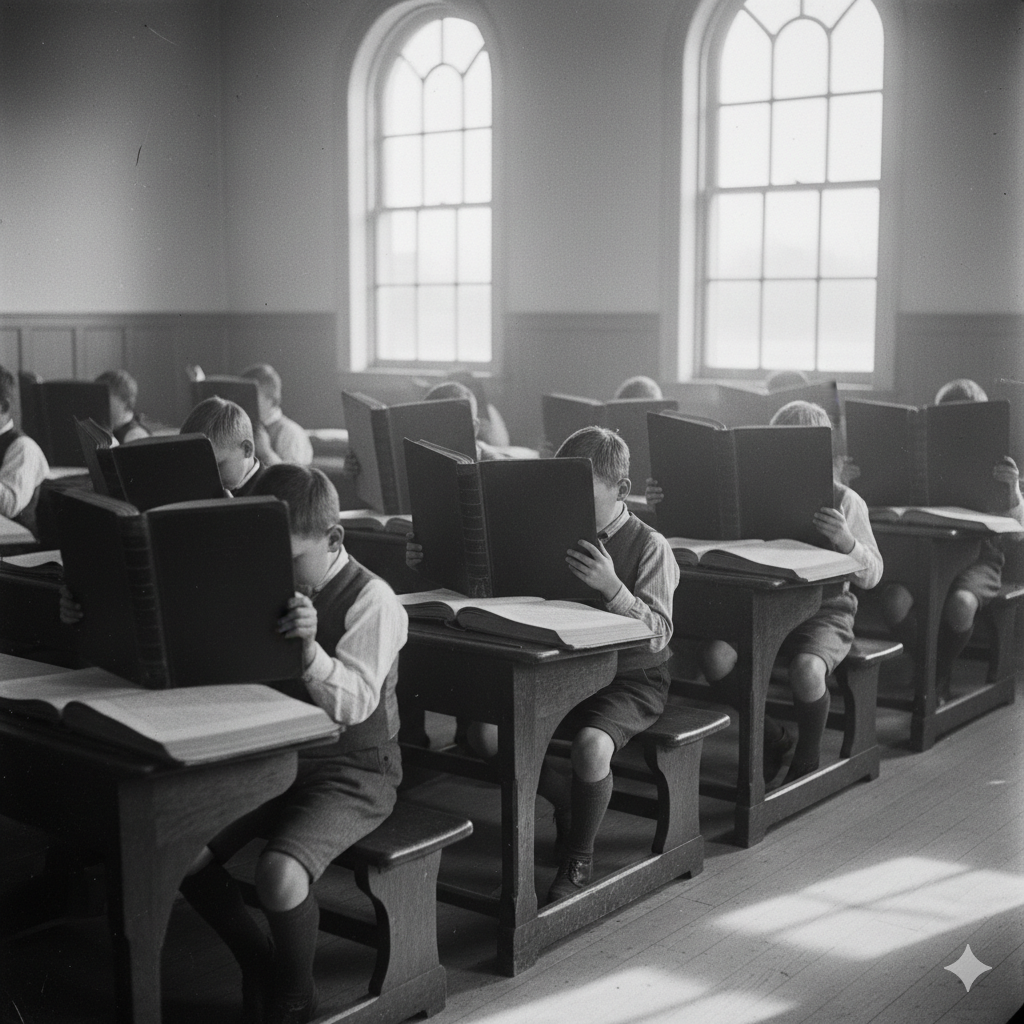
    Books – the paper-printed, page-bounded objects that demand both human hands to hold and are preferably read in a sitting position – started to be manufactured about 550 years ago. 

    Its design was an engineering revolution in its time, featuring a movable-type system and a press that enabled the mass production of printed goods. Compared to scrolls, books were way better (they were more portable and durable) thanks to their bound pages, which allowed non-linear access via pagination.

    In turn, pagination allowed books to display their references and sources at their ends, and an intricate system of small symbols, numbers, and letters was created at the time.

    Despite its design choices being pragmatic solutions to the constraints of technology and materials at the time, regarding their purposes, books were initially developed with the (almost exclusive) objective of educating human males, targeting their behaviour, concerns, minds, and bodies.

    Because the very experience of reading a book was a luxury that very few in human societies worldwide could afford, books were assigned, since their birth, with a status of charm, wisdom, and exclusivity – they rapidly became symbols of wealth, knowledge, learning, and intellect. 

    Precisely because of its initial association with superiority and wisdom, as objects, (their design and content) books have remained unquestioned and unchallenged by humans since their initial launch. 

    The fact that more humans (like females) have been increasingly granted the privilege of reading and learning from books over the past 100 years, together with the fact that digital devices have been revolutionizing access to knowledge over the past 20 years, makes it imperative that objects that provide reading experiences have to suit the minds, bodies, and the social concerns of the contemporary humans – which today means ALL humans.

    Following this line of thought, considering that reading experiences are intended to reach all humans, printed publications in general should be lightweight and easy to hold with one hand (like digital devices), with a single-page flip. This format allows immersive reading in any position (lying down, sitting, standing) without any physical discomfort.

    Today, it is known that while reading a book, humans absorb not only the meaning of the words but also their spatial distribution – a form of spatial memory. This means humans are involuntarily recording the position of the text on a page – whether it is on the right or left side of the book, or at the top, middle, or bottom of the page. 

    To address and enhance this human skill, the single-page flip should use a page layout that displays elements for navigation, such as titles, chapters, subtitles, page numbers, and so forth, as well as keywords related to the text, which make use of and reinforce the human spatial memory. 

    Books today still adopt the confusing and uncomfortable way of displaying references and sources established a long time ago, forcing the reader to navigate a labyrinth of small fonts to access (often trivial) information. This old system still treats supplementary information as an optional appendage rather than an integral part of the intellectual journey. This way of displaying references and sources is merely an outdated convention, not a scientific method. 

    References and sources should be a valuable asset, displayed comfortably on the same page as the content they relate to, making the reading experience easy and fluid.

    In an age of hyperlinks and interactive media, digital devices should also follow the same principles, displaying defined pages with the advantage that all sources/references are clickable links that seamlessly connect the reading content to online resources.

    Because reading is (still) one of the most efficient ways humans can learn, reading devices must adapt their purposes and fulfill their functions. 

    Perhaps what is needed for humans to read more is not willpower, but simple design adaptation, both in their physical design as objects and in the display of their content.

    Reading is not just an act of willpower; it is an experience shaped by design.

    Quietly decoding written words and being taken by its loud silence is one of the most transformative and fulfilling human experiences. And it can definitely be an even more efficient, comfortable, and pleasant one. 

  • Monetization and Architecture

    Monetization and Architecture

    Architecture’s centuries-old pact with power left it economically irrelevant. Now, individual and information power offer a path to redemption.

    Location, size, and number of rooms. In this order, these factors determine the value of properties in cities worldwide. 

    Architecture, who happen to be the entity (mainly) responsible for depicting properties (in some cases, also spaces) in cities, has surprisingly little (close to none) economic influence on property value outcomes. 

    To illustrate, in any given city, two well-preserved buildings with two-bedroom apartments of similar size, in the same neighborhood, will be valued at almost identical price points. If one of those buildings happened to be designed by an extraordinarily significant architect, the property value might increase by 1% to 2%. Maximum. 

    When it comes to architecture and real estate, the former has been rendered economically (practically) invisible. This is not an anomaly at all. This is the foundational rule of the global real estate market, and it reveals a profound, self-inflicted crisis at the heart of architecture. 

    Today, architecture is paid for only at the “birth” of the building, essentially as a service fee. For the rest of the building’s life, while it generates immense economic value through rent and resale (spanning decades or even centuries), architecture has been severed from the financial property value (that it has helped to create).

    How did architecture get here? Well, the current connection between architecture, property value, and urban development is not a recent failure of taste. It is well explained by the relationship architecture established in its early years with empires, kingdoms, and religious organizations first, followed by the State and an industrial elite second. 

    With empires, kingdoms, and diverse religious organizations, architecture was always ready to attend to the desires of their authorities (their clients), always prioritizing their wishes at the expense of the common good. 

    To illustrate, not that long ago, architecture focused primarily on designing the exteriors of palaces, while cities expanded way beyond their scope. This fact contributes to architecture continuing to be seen as a city landscaper rather than a city planner. 

    The same principle applies to the role architecture played in the Industrial Revolution, with a huge focus on the appearance and design of industries, rather than understanding and contributing to the industrial infrastructure. 

    On the path to establishing this design-oriented perspective, architecture primarily focused on legitimizing power, creating a “correct” and “rightful” vision of spaces that has been highly effective in reinforcing this very social order. 

    This cage keeps architecture encapsulated in this outdated artistic realm, always grasping with the tip of its nails to its sacred birthright of being this source of “correctness and rightfulness regarding spaces,” together with its loyalty above all to the elites. 

    The fact that “not everyone understands architecture” or “not everyone enjoys architecture” is often attributed to the wrongness of the human experiencing it. 

    In other words, when a building is ugly, uncomfortable, or confusing, it is never the architecture’s failure to communicate, accommodate, or delight. It is as if architecture is not even made for humans. 

    Well, while architecture was looking (and still is) the other way, clinging to its old patrons, the world changed. By prioritizing this toxic loyalty to the elites, architecture rendered itself irrelevant to the most significant driver of value in the modern world: the market. 

    From this perspective, architecture became not just a cultural problem – it became an economic one. The real estate industry developed a standardized, easily quantifiable language (square meters, zip code, room count) because that is what the mass market understands and can trade on. With its subjective talk of “spatial quality” and “materiality,” architecture ended up having no place in the equation, location + size + number of rooms. 

    Yes, elites are still major game changers in societies and cities worldwide. Still, other kinds of societal powers have been emerging – information power (the ability for knowledge, data, and critique to be generated and distributed by anyone, anywhere) and individual power (the empowered consumer). 

    Architecture, somehow, seems to be utterly oblivious to them. It continues to pitch its services to corporate boards and state committees, the modern equivalents of its old patrons, while ignoring the vast, untapped power of the networked individual.

    With individuals having more choice, more access to information, and more agency than ever before, they have become the new patrons, demanding spaces that serve their needs rather than an abstract architectural ideal. 

    Architecture needs to start acknowledging that, as of 2025, there are no humans inhabiting the earth’s surface who, out of their own choice and will, would prefer the ugly, the bad, and the uncomfortable. 

    It has never been a better time for architecture to experiment with information and individual power, reclaiming its well-deserved authority to dictate and heavily influence the market it is part of. 

    Architecture needs to finally position itself as a necessary instrument to shelter human relationships, making life more comfortable and better. 

    Instruments, theories, information, know-how. Architecture already has a lot of it. Architecture can change and be a part of the contemporary world.

    Architecture only needs courage.

  • Beliefs of a Female Architect

    Beliefs of a Female Architect

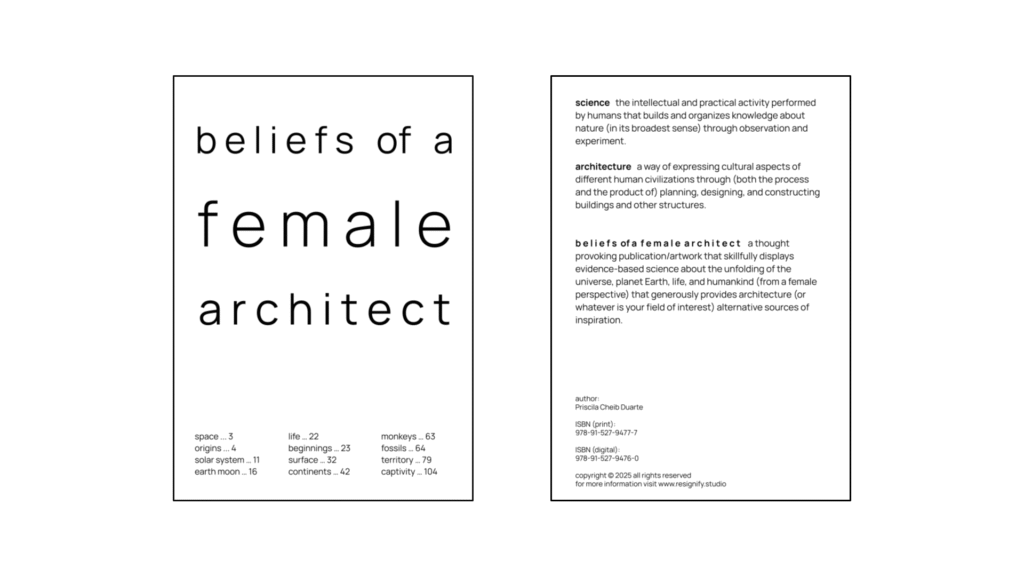
    An evidence based narrative about the Universe, Planet Earth, Life, and Humankind

    Since humans began inhabiting the Earth’s surface, approximately 600.000 years ago (or 1.800.000 years ago, depending on the evidence considered), they (like other animals) sought to understand themselves and their surroundings, gathering knowledge in order to better reproduce and survive.

    By 5000 years ago, humans started to register the knowledge (which they consider to be fundamental for their reproduction and survival) in the form of written records. In turn, the ancient written records have granted the following human generations very limited yet very important access to the ancient human world.

    Interestingly, from what contemporary humans can (so far) interpret from those ancient written records, it appears that they are (almost entirely) related to a system of beliefs, centered on a connection to the spiritual or the supernatural.

    These systems provide moral guidance, and more importantly, they function as a powerful social glue, gathering large, disparate groups of humans under a shared set of dogmas and a common identity.

    Over the last 500 years, humans have been intensively documenting, accumulating, and systematically organizing their knowledge (and beliefs) about nature (in its broadest sense) through observation and experimentation, in an intellectual and practical activity called science.

    It is important to highlight that since its emergence (and especially in its beginnings), science has been formalized as an intellectual path to the truth, mediated by divine revelation, in other words, a means to confirm the spiritual and supernatural through rationality and the human intellect.

    Therefore, science has been operating mainly as a way to find evidence that proves the dogmas or the very existence of the diverse systems that humans believe in the spiritual (or supernatural).

    This intricate association between empirical science and metaphysical beliefs has persisted into our modern era. Over the last 35 years, academic fields such as Big History, as well as books, TV shows, and various forms of media, have been attempting to make sense of human existence on Earth from a more scientific perspective.

    Despite having significantly more data and empirical evidence (compared to 500 years ago, when science itself was still crawling), the “modern” science often finds itself walking a tightrope.

    To remain palatable and relevant within a global culture, still deeply rooted in spiritual traditions, it frequently adopts a posture of deference. It presents itself not as a replacement for creation myths, but as a complementary, “modern origin story” that can sit alongside them.

    Therefore, science today heavily depends on the promotion (and perpetuation) of dogmas and the very existence of diverse belief systems that humans hold regarding the spiritual (or supernatural), purposefully avoiding a direct confrontation with them.

    Over the last 20 years, the Internet (which was first researched about 65 years ago, then became available to the general public about 30 years ago, but really took off in terms of volume of usage and content about only 15 years ago) has been able to democratize access to all kinds of data and knowledge, making the present time unprecedented in history regarding access to information. 

    Given this recent scenario full of possibilities, an interesting mission started to take shape. Would it be possible, by accessing the Internet, to disentangle the vast scientific knowledge based exclusively on empirical evidence into a cohesive, compelling narrative about the origin and unfolding of the universe, planet Earth, Life, and humankind?

    Within these premises, the mission unfolded (over some years) in chronological sequence, following the events that brought humans into existence from the past to the present day.

    There was no specific goal to be reached or a thesis to be proved.

    The main objective was to simply substantiate the available scientific knowledge based on empirical evidence regarding the universe, planet Earth, Life, and humankind.

    After some years, the mission resulted in a thought-provoking publication, an artwork of liberation, intellectual honesty, and the reality of the human circumstances, whose delivery is as factually rigorous as it is narratively compelling – Beliefs of a Female Architect.

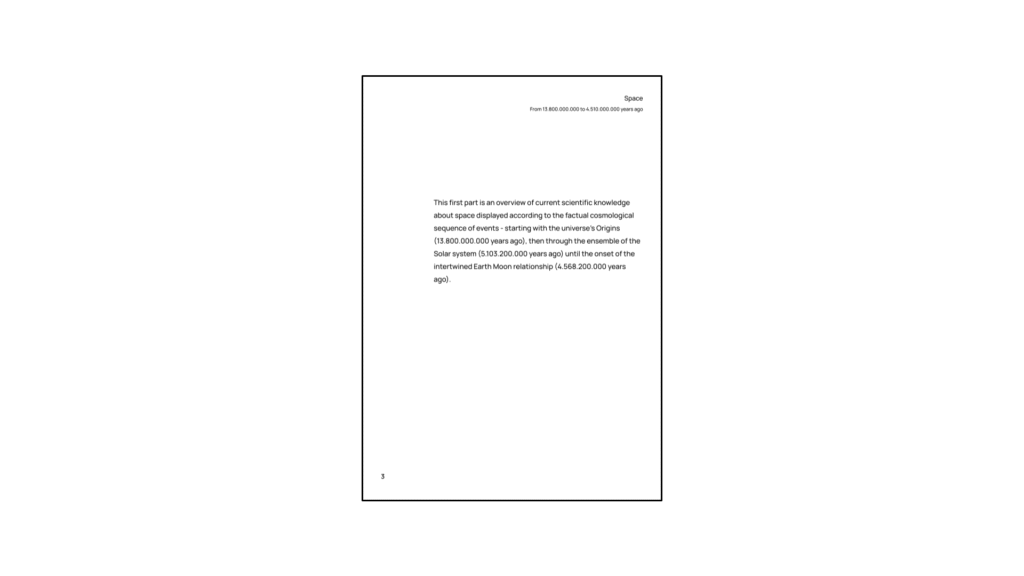
    In its first part, called Space, Beliefs of a Female Architect offers an overview of what happened in the universe from the Big Bang to the formation of the Moon and Earth (based exclusively on empirical evidence) in accordance with the factual cosmological sequence of events. It starts with the universe’s Origins (13.800.000.000 years ago), then moves through the ensemble of the Solar system (5.103.200.000 years ago) until the onset of the intertwined Earth-Moon relationship (4.568.200.000 years ago).

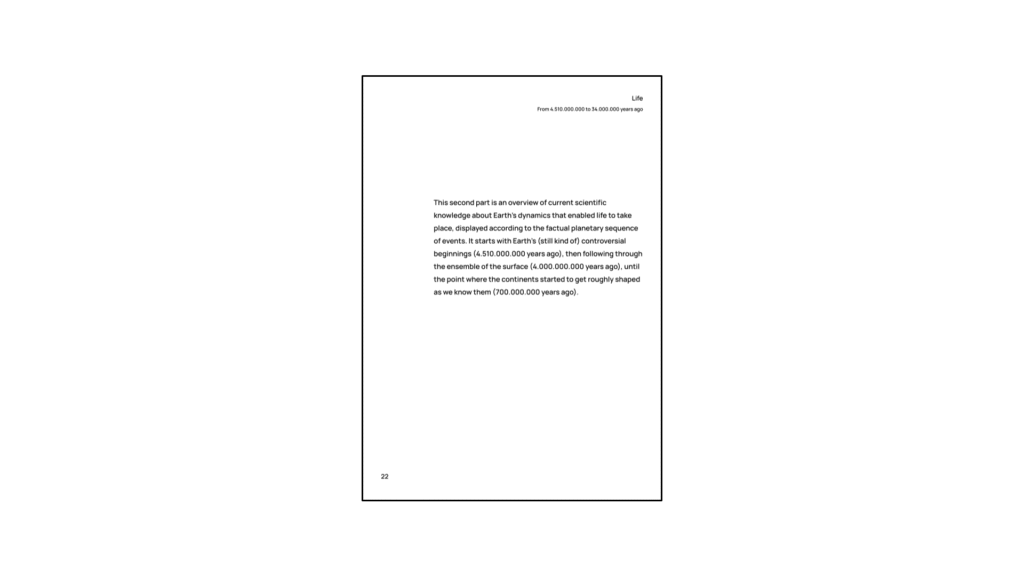
    In its second part, called Life, Beliefs of a Female Architect goes a little deeper into Earth’s dynamics that enabled Life to take place (also based on empirical evidence), this time displayed according to the factual planetary sequence of events. It starts with Earth’s (still kind of) controversial beginnings (4.510.000.000 years ago), then progresses through the ensemble of the surface (4.000.000.000 years ago), until the point where the continents started to get roughly shaped as we know them (700.000.000 years ago).

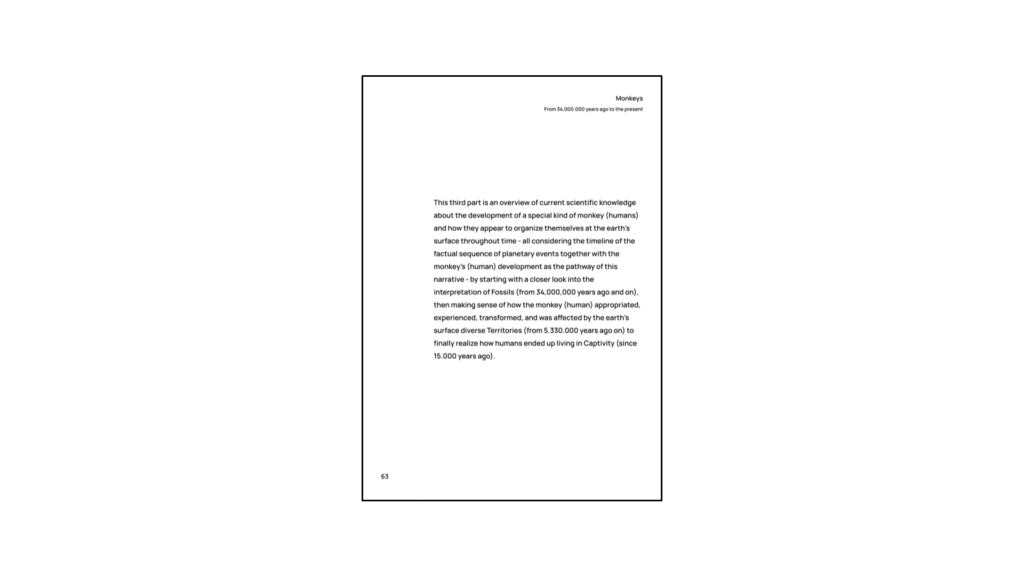
    In its third part, called Monkeys, Beliefs of a Female Architect provides a generous overview of current scientific knowledge (still based on empirical evidence) about the physical development of a special kind of monkey (humans) and how those monkeys (humans) have been organizing themselves on the Earth’s surface throughout time. The narrative considers the timeline of the factual sequence of planetary events, along with the monkey’s (human) development, as its pathway. It starts with a closer look into the interpretation of Fossils (from 34,000,000 years ago and on), then making sense of how the monkey (human) appropriated, experienced, transformed, and was affected by the Earth’s surface diverse Territories (from 5.330.000 years ago on) to finally realize how humans ended up living in Captivity (since 15.000 years ago).

    The author of Beliefs of a Female Architect is a human architect. Since architecture itself is part of the empirical evidence of humans inhabiting the Earth’s Surface, architecture is also a portion of the narrative. However, Beliefs of a Female Architect is not a publication about architecture, nor is it exclusively for architects.

    Beliefs of a Female Architect is a publication for all humans. Students, academics, scientists, intellectuals, philosophers, architects, engineers, mothers, fathers, and above all, to all individuals who are simply curious about what humans actually (evidence-based) know so far about themselves and their place in the universe.